
What is Social Media

Social media has become an integral part of modern human life, influencing how people communicate, share information, and connect across the world. In simple terms, social media refers to digital platforms and applications that enable users to create, share, and exchange content or information in virtual communities. These platforms allow people to interact instantly, irrespective of geographical boundaries, and have transformed communication into a dynamic, two-way process. Over the past two decades, social media has grown from simple networking sites into powerful tools that shape public opinion, culture, business, education, and even politics.
Definition and Meaning
The term social media is a combination of two words: social, meaning interaction with people, and media, referring to communication tools or channels. Therefore, social media means online platforms that facilitate social interaction and media sharing. Unlike traditional media such as newspapers, television, or radio, social media allows user-generated content—where individuals can create, post, and discuss information in real-time. According to experts, social media includes all forms of interactive digital communication channels, such as Facebook, Instagram, Twitter (now X), WhatsApp, YouTube, Snapchat, and LinkedIn, among others.
Evolution of Social Media
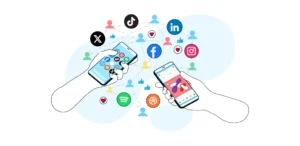 The evolution of social media began in the late 1990s with the emergence of websites like SixDegrees.com, which allowed users to create profiles and connect with friends. The early 2000s witnessed the rise of platforms like Friendster, MySpace, and Orkut, which popularized online networking. However, the real revolution came with Facebook, launched in 2004, which completely changed how people interacted online. Later, platforms like YouTube (2005) brought video sharing, Twitter (2006) introduced microblogging, and Instagram (2010) and Snapchat (2011) revolutionized visual communication. Today, social media has diversified into various forms, including short-form video apps like TikTok, professional networks like LinkedIn, and messaging platforms like Telegram and WhatsApp.
This continuous innovation has made social media an inseparable part of the global communication system, bridging gaps between individuals, organizations, and governments.
Types of Social Media
Social media can be categorized into several types based on functionality:
-
Social Networking Sites – These platforms, such as Facebook, Twitter (X), and LinkedIn, focus on connecting users to share updates, opinions, and experiences.
-
Media Sharing Networks – Platforms like Instagram, YouTube, and TikTok allow users to share photos and videos.
-
Discussion Forums – Websites like Reddit and Quora enable people to exchange ideas and opinions on specific topics.
-
Messaging Apps – WhatsApp, Messenger, and Telegram focus on direct communication between users.
-
Blogging and Microblogging Sites – Platforms like Tumblr and Twitter let users publish short posts and updates.
-
Collaborative Projects – Wikipedia is an example where users collectively create and edit content.
-
Social Commerce Platforms – Websites like Pinterest and Facebook Marketplace combine shopping with social networking.
Each of these types serves unique purposes but contributes collectively to building virtual communities and enabling online interaction.
Uses and Importance of Social Media
Social media plays a vital role in almost every aspect of human life. It is not only a source of entertainment but also a tool for education, marketing, governance, and activism.
-
Communication and Connectivity – Social media connects people across continents instantly. Friends and families can stay in touch, and individuals can make new connections easily.
-
Information and Awareness – It has become a primary source of news and information, often faster than traditional media. People share updates on world events, trends, and innovations.
-
Education and Learning – Teachers, students, and institutions use social media to share learning materials, conduct online classes, and promote digital literacy.
-
Business and Marketing – Companies use social media for advertising, branding, and customer engagement. Influencer marketing and social media campaigns have transformed business strategies.
-
Social and Political Impact – Social media is a platform for raising voices, organizing movements, and spreading awareness on social issues such as climate change, gender equality, and human rights.
-
Entertainment and Creativity – It provides endless opportunities for creativity through videos, memes, music, and art. Platforms like YouTube and TikTok have made ordinary users global celebrities.
Advantages of Social Media
The advantages of social media are numerous:
-
It promotes global communication and knowledge sharing.
-
It offers real-time access to information and news.
-
It helps small businesses reach large audiences at low cost.
-
It encourages creativity and self-expression through digital content.
-
It provides a platform for social awareness and activism.
In essence, social media has democratized information and and Challenges
empowered individuals to have a voice in public discussions.
Disadvantage of Social Media
- However, social media also comes with drawbacks. The easy access to information sometimes leads to misinformation and fake news. Overuse can result in addiction, anxiety, and reduced productivity. Privacy issues and cyberbullying are also major concerns. Moreover, the constant comparison and pursuit of validation through likes and followers can negatively affect mental health. Therefore, responsible usage and awareness are essential to prevent its misuse.
Conclusion
In conclusion, social media is one of the most influential inventions of the 21st century. It has changed how people communicate, learn, work, and express themselves. While it offers countless benefits, its negative effects cannot be ignored. Hence, the key lies in using social media wisely and responsibly—to connect, educate, and empower rather than to divide or mislead. As technology continues to advance, social media will undoubtedly evolve further, continuing to shape the way humanity interacts and shares ideas in the digital age.